

Completing a trilogy on the evolution of sex
By Yukio Yasui
One of the oldest questions in evolutionary biology is how gametic sexual reproduction originated and why it has persisted despite its apparent costs. Together with two previous studies, this JEB paper completes what I regard as a trilogy on the origin, evolution, and maintenance of anisogamy and sexual reproduction.
The immediate challenge posed by female-only reproduction
The twofold cost of sex is an immediate demographic cost: males consume resources but do not themselves produce offspring. Obligate thelytoky should therefore gain an immediate advantage by producing only daughters. Why, then, does it not readily replace anisogamy?
Meiosis creates a first-generation barrier
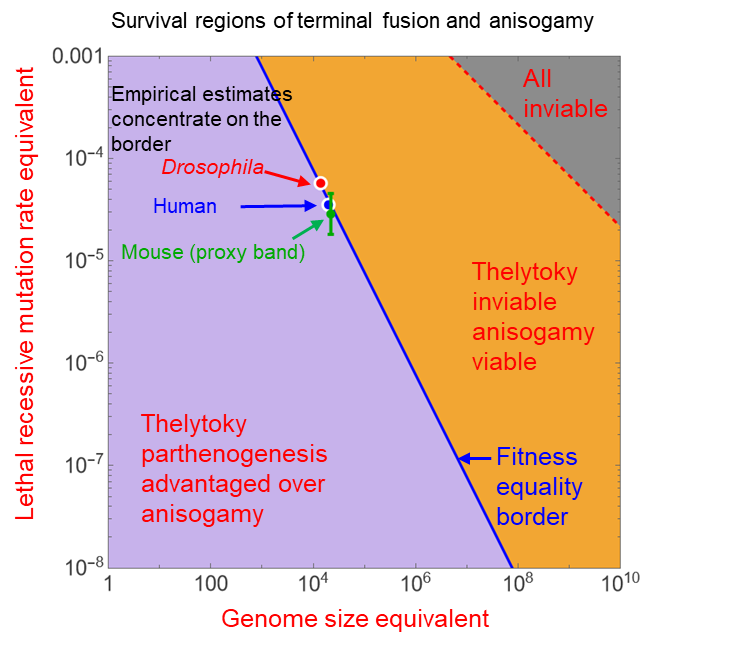
In many metazoans, oocyte meiosis pauses before completion and resumes only after fertilization, although the precise arrest stage differs among taxa. The present paper shows that, even without considering male-derived benefits, this coupling creates an immediate barrier against obligate thelytoky (Fig. 1): in an unfertilized state, the egg remains incomplete and cannot initiate embryonic development unless an alternative mechanism releases the arrest.
The alternatives are costly. Haploid development exposes recessive lethal mutations, while terminal fusion restores diploidy by fusing the ovum with a polar body but causes extreme homozygosity and inbreeding depression. Most new thelytokous lineages may therefore be eliminated in their first generation, before realizing their apparent twofold advantage.
Empirical estimates lie near the fitness-equality border
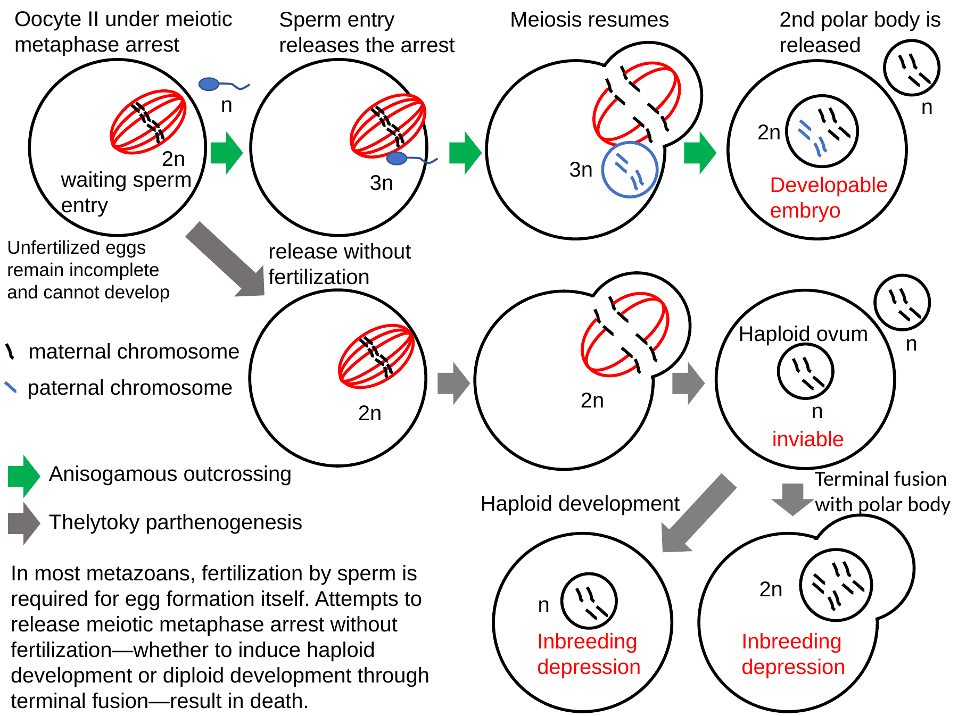
The analytical model identifies when terminal-fusion thelytoky is favoured, inviable, or equal in fitness to anisogamy. Empirical estimates from Drosophila, mouse, and human (Fig. 2) all cluster near the fitness-equality border. At this boundary, an unfertilized egg choosing terminal-fusion thelytoky loses approximately half of its embryos through expression of recessive lethal mutations, reducing its fitness to that of anisogamy despite the twofold cost of producing males. These species may therefore lie near a genomic cliff edge: sexual reproduction remains viable, whereas an immediate transition to female-only reproduction exposes a lethal load. Testing additional species will determine whether this pattern is general.
Think different
Meiotic metaphase arrest has been studied since the 1970s, mainly in molecular and developmental biology. Its significance has usually been framed as preventing haploid oocytes from initiating embryogenesis, not as a mechanism relevant to the twofold cost of sex. The connection becomes visible only by combining cell biology with evolutionary theory. The Red Queen and Müller’s ratchet describe genetic benefits of sex that emerge over multiple generations. A thelytokous mutant, however, gains its demographic advantage immediately. A mechanism that prevents its invasion must therefore act within the same generation. The meiotic constraint does so.
How the paper completes the trilogy
The first paper (Yasui and Hasegawa 2022) addressed how gametic sex and anisogamy could arise. The seesaw effect proposes that, when deleterious mutations are unevenly distributed between the two genomes of an ancestral diploid, terminal-fusion automixis can unite two relatively mutation-poor gametes produced by the same individual, allowing the first sexual lineage to reproduce without an external mate. The inflated isogamy hypothesis proposes that, with the evolution of multicellularity and increased resource availability, both mating types could first enlarge their gametes. Thus, creating a resource surplus that subsequently allowed one mating type to evolve smaller, more numerous gametes and providing an intermediate route from isogamy to anisogamy.
The second paper (Yasui 2026) proposed double-income anisogamy: male resource defence, although evolved as a selfish mating strategy, can increase the resources available to females and offspring and thereby offset the immediate demographic cost of males. The present JEB paper supplies the remaining element by showing how meiotic mechanisms prevent anisogamy from being readily invaded by female-only reproduction.
Double-income anisogamy is an adaptive explanation, whereas the meiotic-constraint hypothesis is a constraint explanation. Importantly, both operate within the same generation.
A unified explanation for sex and asexuality
Taken together, the three papers lead to a broader explanation for the distribution of sexual and asexual reproduction in nature.
Most organisms that undergo meiosis are subject to a severe constraint: if they lose sex, reproduction fails immediately. This first-generation barrier allows males to be maintained even though anisogamy carries the twofold cost of sex. In more complex organisms, where social interactions among individuals are important, male acquisition, defence, or provision of reproductive resources can further offset that cost.
Asexual reproduction that bypasses meiosis, including apomixis, can evolve. In multicellular animals, however, it is constrained by the difficulty of restoring differentiated somatic cells to a totipotent state. Plants, which commonly retain cellular totipotency and can reproduce vegetatively, and some animals capable of facultative parthenogenesis, such as aphids and Daphnia, can combine anisogamy with asexual reproduction. In these organisms, asexual reproduction can provide rapid population increase, whereas sexual reproduction can provide longer-term genetic benefits, including the purging of deleterious mutations and responses to pathogen-mediated selection. The sexual phase therefore need not outperform asexual reproduction in every generation. Since the cost of males only becomes problematic when competing with asexual rivals, facultative sexual organisms can switch to asexual reproduction at that time. The classic twofold-cost problem therefore applies only to obligately anisogamous organisms that must produce males in every generation.
Organisms that have become entirely asexual through apomixis or similar processes may flourish temporarily; however, as they lose the long-term benefits of sex (the Muller’s ratchet and the Red Queen effect), their adaptive radiation is restricted, leading them towards extinction, and they can only exist on the phylogenetic tree for a short period. This explains the current state of the natural world, in which the majority of multicellular organisms possess both males and females, whilst a small number of species consist solely of females. Through this trilogy, it can be said that the twofold cost of sex—the greatest enigma in evolutionary biology—has been largely resolved from a theoretical perspective. While there are already substantial amounts of empirical evidence, we look forward to further progress in future research.
You can read more about the trilogy and my research here.
References
Yasui, Y. and Hasegawa, E. The origination events of gametic sexual reproduction and anisogamy. Journal of Ethology 40, 273–284 (2022). https://doi.org/10.1007/s10164-022–00760‑3
Yasui, Y. Double-income anisogamy offsets the twofold cost of sex by resource defense. Journal of Ethology 44, 189–206 (2026). https://doi.org/10.1007/s10164-026–00885‑9